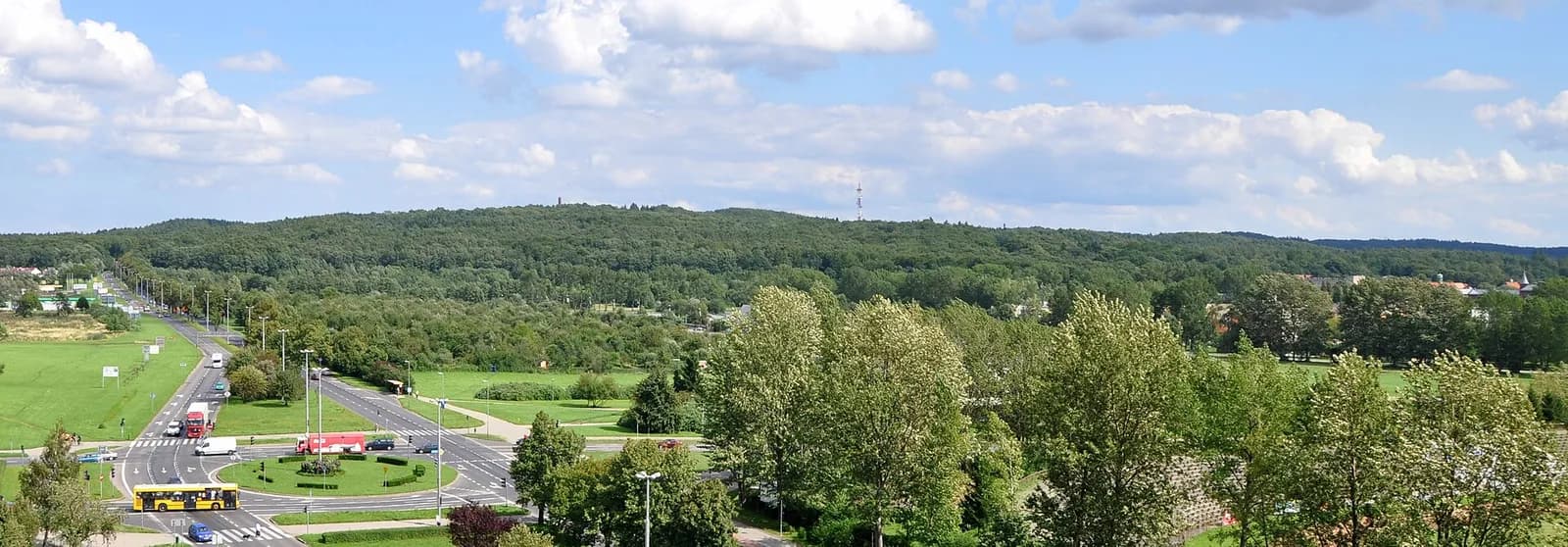
Góra Chełmska rises quietly above Koszalin, its wooded slopes providing a change of pace from the streets below. At 136.2 metres, it is hardly a mountain, but the hill has played a remarkably large part in the history of the city.
Today, people come here to walk through the forest, cycle the trails, visit the sanctuary or climb the historic observation tower at Krzyżanka. Look a little closer, though, and the paths reveal layers of history stretching back to the Middle Ages.
The hill was here before modern Koszalin took shape, and its story has changed with the city around it.
A hill with a medieval past
Long before Góra Chełmska became a popular place for a Sunday walk, it was an important religious site.
A chapel was standing here around the turn of the 12th and 13th centuries. It served the local population before Koszalin received its municipal charter in 1266, and in 1278 patronage over the chapel passed to the Cistercian nuns of Koszalin.
The site developed into a Marian pilgrimage centre during the Middle Ages. A church was begun in 1431, although it was never completed.
That medieval religious landscape eventually disappeared following the Reformation. In 1534, after the Pomeranian rulers adopted Protestantism, the sanctuary was demolished and Góra Chełmska lost its religious role for several centuries.
Walking through the woodland today, it can be difficult to imagine such a prominent medieval centre standing on the hill.
Krzyżanka and the cross designed by Schinkel
The highest point of Góra Chełmska is known as Krzyżanka, a name associated with the cross that once stood here.
The cross was erected in 1829 in memory of those who died during the Napoleonic Wars. Its designer was Karl Friedrich Schinkel, one of the most influential architects of 19th-century Prussia.
The cross itself disappeared in the 1960s, but the name Krzyżanka remained.
It is one of several reminders that Góra Chełmska's history extends well beyond the medieval period and reflects the changing political and cultural landscape of Pomerania.
The tower above the trees
The landmark most closely associated with the hill today is the brick observation tower built in 1888.
Standing 31.5 metres high, the tower was constructed during a period when Góra Chełmska was becoming a popular destination for leisure and recreation. Visitors could make the climb for views over Koszalin and the surrounding landscape, with Lake Jamno and the Baltic visible towards the north.
There are 140 steps to the viewing platform.
The tower became part of a wider leisure complex. A restaurant followed in the 1890s, while walking routes and sporting facilities helped turn the hill into a favourite destination outside the city.
Góra Chełmska was already a place for getting outdoors long before hiking and cycling became the familiar weekend activities they are today.
From winter sports to forest walks
Historical accounts describe a surprisingly varied recreational life on the hill.
There were sporting facilities, winter activities, tobogganing and even a bobsleigh run. In the years after the Second World War, efforts were made to restore Góra Chełmska as a recreational area, including improvements to the tower and the development of tourist facilities.
Some of those attractions have disappeared, but the basic appeal has remained.
The forest provides a network of routes through the moraine landscape, with sections that can be considerably steeper than the modest height of the hill might suggest.
One of the better-known routes is the Pętla Tatrzańska, which takes walkers through the surrounding hills on a route of roughly 11 kilometres. Other trails connect Góra Chełmska with the wider Koszalin area.
Cyclists have their own reason to head into the woods, including the Single Track system created in 2019 through the Koszaliński Budżet Obywatelski.
The sanctuary returns
Góra Chełmska's religious history entered a new chapter towards the end of the 20th century.
In 1990, following efforts by Bishop Ignacy Jeż, the site was returned to the Church. The Szensztacki Instytut Sióstr Maryi took responsibility for the religious complex and established the present sanctuary dedicated to Matka Boża Trzykroć Przedziwna.
A year later, on 1 June 1991, Pope John Paul II visited Koszalin and consecrated the sanctuary.
His visit placed Góra Chełmska firmly within the modern pilgrimage history of the city and gave the hill a new role after centuries without an active sanctuary.
The religious and recreational sides of the hill now sit alongside one another, with the sanctuary, woodland paths and observation tower forming a distinctive combination.
Góra Chełmska today
The hill has settled into a quieter role than it had during some periods of its past.
There is no need for a grand occasion to visit. A walk through the trees, a climb to Krzyżanka or a few hours on the trails are enough to reveal why the hill has remained part of everyday life in Koszalin.
At the same time, the surviving landmarks give the woodland a sense of depth. The tower recalls the recreational resort of the late 19th century. The sanctuary connects the hill with both its medieval origins and its modern religious revival. The archaeological remains point to a much older landscape, while the paths continue a tradition of people coming here simply to spend time outdoors.
Góra Chełmska has changed repeatedly, but it has never really disappeared from the story of Koszalin.
Today, the view from Krzyżanka brings those different chapters together. The city is below, the Baltic lies beyond the landscape, and the forest around the tower still provides the same simple reason people have been coming here for generations: to get away from the streets for a while.
See more: Park Książąt Pomorskich, 400 Years of History
Image credit: JDavid, Wikimedia Commons, CC BY-SA 3.0