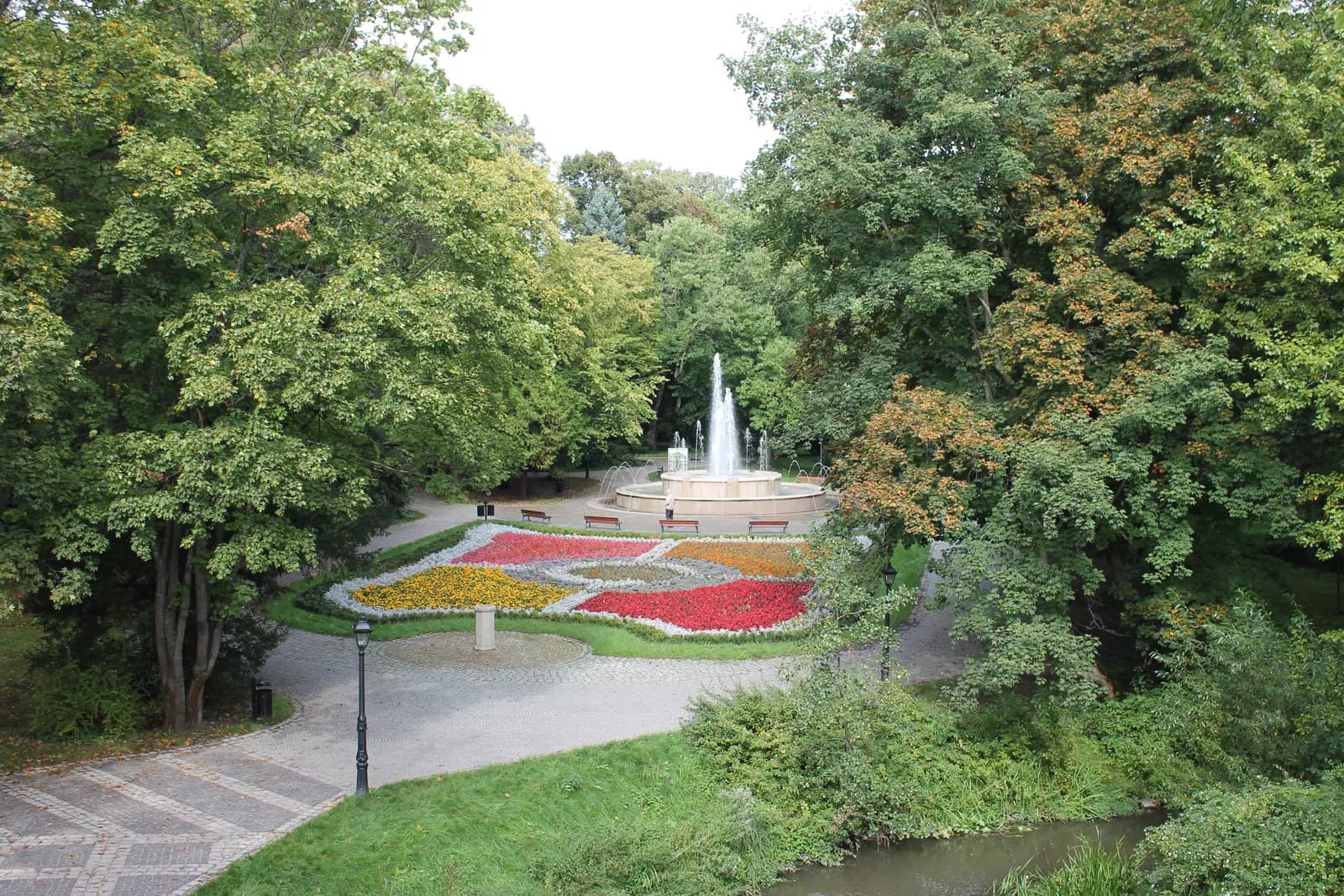
Few places in Koszalin reveal the city's changing identity as clearly as a park shaped by more than four centuries of history.
A walk through Park Książąt Pomorskich can feel like a simple escape from the city, but its landscape carries more than four centuries of Koszalin’s history. Along the Dzierżęcinka river, beneath mature trees and beside the Castle Pond, different periods of the city’s past remain visible in the landscape.
The park forms part of a larger green corridor through central Koszalin, connecting areas around Rzeczna and Targowa streets with the vicinity of Kutrzeby Street. Its best-known northern section, Park Książąt Pomorskich "A", covers 6.70 hectares, including the pond and section of the Dzierżęcinka. The park complex is protected as a historic monument and was entered into the register of monuments in 1983.
From a princely garden to a public promenade
The story begins long before the park acquired its present form. Its origins are associated with the reign of Bogusław X, when a castle garden and pond lay beneath the medieval defensive walls of Koszalin.
The landscape changed gradually. The Stara Promenada, or Old Promenade, became the oldest recognisable part of today's park. Work began in 1602, while 1817 is traditionally regarded as the formal date of the park's creation. The promenade followed the line of the city's defensive walls, turning a landscape once associated with fortifications into a place for walking and recreation.
The transformation continued in the 19th century. Between 1837 and 1838, the Koszalin regional president August Ludwig Leopold Fritsche initiated further work, including new walking avenues, the regulation of the Dzierżęcinka, changes to the pond and the construction of a fountain. By the 1930s, another major reshaping had taken place. In 1933–1934, the Castle Pond was restored and an island for swans was created.
What emerged was not a landscape designed at one particular moment, but one built up through successive generations. That gradual development helps explain why the park feels closely connected to both the historic centre and the natural landscape around it.
The names of a changing city
The park's history is also reflected in its names.
For centuries, the Stara Promenada described its oldest section. In the post-war period, it was renamed Park Przyjaźni Polsko-Radzieckiej, or Polish-Soviet Friendship Park, reflecting the political language of communist Poland. After 1989, the earlier political name disappeared and the area was for a time referred to simply as the municipal park. It was eventually given its present name, Park Książąt Pomorskich, reconnecting the landscape with the historical rulers of Pomerania.
The vegetation provides another way of reading the park's history. Koszalin's municipal information records 124 species and varieties of trees and shrubs in Park Książąt Pomorskich "A", including the Amur cork tree, swamp cypress, ginkgo and the city's only tree magnolia. The avenue of London plane trees is another distinctive feature.
Among the park's most memorable historical trees was the more than 300-year-old sycamore maple known as Drzewo Czarownic, or the Witch's Tree. Its popular name was linked to the nearby historic Domek Kata and local legends concerning witchcraft and executions. The tree was brought down by a storm in 2011, ending the life of one of the city's best-known natural landmarks.
The Domek Kata itself remains close to the park. Dating in its present historic fabric to the Gothic period, the building was associated with Koszalin's executioner and today houses Teatr Propozycji "Dialog". Its presence adds another layer to an area where documented history and local legend have long overlapped.
A landscape that remembers
The park also contains reminders of a much darker chapter.
A memorial marks the site of Koszalin's former synagogue, which was destroyed by the Nazis during Kristallnacht on 9 November 1938. The memorial preserves the physical memory of a Jewish community that formed part of the city's pre-war life, ensuring that the park's history cannot be reduced to gardens, promenades and architecture alone.
That mixture of beauty and difficult memory is central to understanding Park Książąt Pomorskich. Its paths cross spaces shaped by medieval defences, princely history, 19th-century urban planning, political change, wartime persecution and modern conservation.
Today, the park remains part of everyday Koszalin. People pass beneath its trees, walk beside the Dzierżęcinka and gather around the Castle Pond, often without needing to think about the centuries contained within the landscape.
Yet that is precisely what makes the park significant. It does not preserve Koszalin's history behind glass or within a single building. Instead, the history remains woven into the city itself, where a promenade, a pond, an old tree, a surviving historic building and a memorial can each offer a different glimpse of the place Koszalin has become.